
Water ingress is one of the leading causes of long-term building deterioration. Through remedial engineering investigations, many significant structural defects can be traced back to surprisingly small design details. This project, undertaken by Intrax’s Remedial Asset team at Falls Creek, demonstrates how a seemingly minor window sill design contributed to years of timber deterioration, moisture damage and costly repairs.
A “Sill”y Detail, a Costly Outcome: How a Flat Window Sill Led to Significant Timber Damage
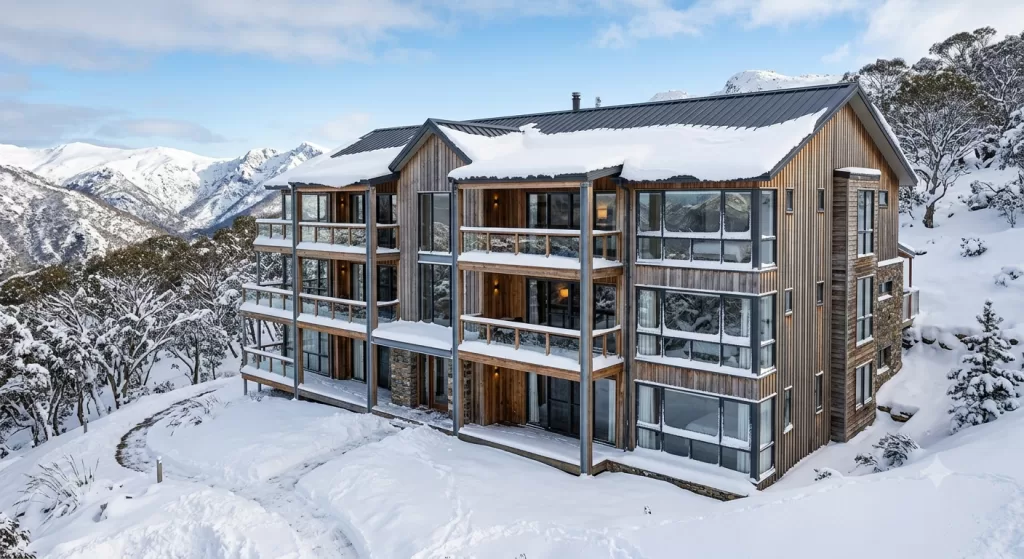
Snow season is in full swing across Australia’s alpine regions. While visitors are enjoying fresh snow and mountain views, building owners and asset managers face a different challenge: protecting their buildings from the harsh conditions that come with prolonged snow, moisture and freeze–thaw cycles.
Snow might look picturesque from inside a warm apartment, but when it sits in the wrong place for long enough, it can become a building’s worst enemy.
That’s exactly what Intrax specialists discovered during a remedial engineering investigation at a serviced apartment building in Falls Creek, where one seemingly minor detail—a flat timber window sill—had quietly contributed to years of moisture exposure, timber deterioration and water ingress.
It’s a great example of how small design details can have significant consequences over the life of a building.
The Challenge – Investigating Water Ingress and Timber Deterioration
The Intrax Forensic Team was engaged to investigate building defects affecting timber-framed windows following reports of water ingress and moisture-related deterioration at a multi-level serviced apartment building in Falls Creek.
The concern was straightforward: signs of water ingress and deterioration had been observed in a number of lower-level windows. The building itself was around 20 years old, making it reasonable to initially suspect age-related wear and tear.
However, the investigation quickly revealed that the underlying issue was not simply the age of the building—it was a specific design detail that was exposing parts of the structure to excessive moisture year after year.
What We Found – Building Defect Investigation Findings
During the site inspection, Intrax’s Remedial Asset team assessed window frames throughout the building and compared their performance across different levels.
The lower-level windows incorporated broad timber sills approximately 80–100 mm deep. While seemingly harmless, these sills were largely flat, creating a surface where snow could accumulate and remain in direct contact with the timber for extended periods.
Evidence observed during the investigation included:
- Elevated moisture levels within timber framing.
- Visible softening and deterioration of timber elements.
- Warping and distortion of window components.
- Gaps developing between sill and frame junctions.
- Active water ingress into the building.
The findings became even more compelling when compared with the upper-level windows. These windows did not include the same sill detail and displayed only minor weathering and normal moisture levels.
The contrast pointed to a clear conclusion: the sill geometry was a major contributor to the deterioration occurring at the lower levels.
How Poor Window Sill Design Led to Moisture Damage
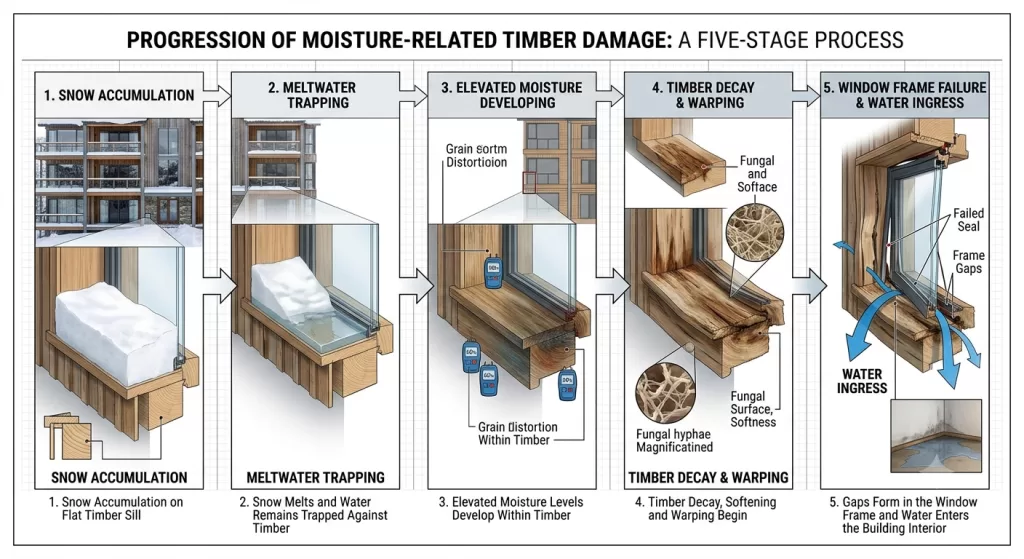
In alpine environments, managing water is critical to long-term durability.
The flat sill design allowed snow to build up directly against the timber frame during winter. As temperatures fluctuated, the snow repeatedly melted and refroze, keeping moisture in prolonged contact with the timber.
Over time, this resulted in:
- Accelerated timber decay.
- Increased moisture penetration.
- Loss of durability and structural integrity within affected components.
- Openings that allowed water to enter the building envelope.
What appeared to be a relatively minor design feature ultimately created ideal conditions for deterioration to occur.
This project serves as a reminder that successful building performance often depends on the details. Even a small horizontal surface can significantly influence how water behaves over the life of an asset.
Developing a Remediation Strategy
Like many remedial projects, the solution required both immediate risk mitigation and longer-term planning.
Short-Term Measures
To slow deterioration and extend the life of the existing windows, Intrax Forensic Specialists recommended:
- Repairing damaged timber using appropriate restoration products.
- Applying protective exterior coatings.
- Designed a temporary metal flashing to slope away from the building and minimise snow contact with the timber.
While these measures do not eliminate the underlying issue, they can help reduce further deterioration and provide additional service life when combined with ongoing inspection and maintenance.
Long-Term Solution
The preferred long-term approach focuses on addressing the root cause of the problem.
Recommended works included:
- Replacement or substantial remediation of the affected lower-level timber frames.
- Modification of the sill detail to prevent snow accumulation.
- Installation of appropriately designed flashing and weatherproofing elements that promote positive drainage away from the building.
The key lesson is simple: repairs alone are rarely enough if the original moisture-trapping detail remains unchanged.
Lessons for Asset Owners
This project reinforces several important principles for property owners, building managers and designers:
- Small design details can have significant long-term impacts on building durability.
- Water management should always be a primary consideration, particularly in harsh or exposed environments.
- Horizontal surfaces adjacent to timber can create ongoing maintenance and deterioration risks.
- Early investigation of moisture-related defects can prevent larger and more costly remedial works in the future.
- Effective remediation addresses the cause of deterioration, not just its symptoms.
Why Early Building Defect Investigations Matter
At Intrax, remedial engineering is about more than fixing what has gone wrong. It’s about understanding why a building is underperforming, identifying the root cause and developing practical solutions that extend asset life and reduce future risk.
The Falls Creek project demonstrates how a seemingly minor window detail evolved into a significant maintenance issue over time. More importantly, it highlights the importance of early building defect investigations. By identifying moisture ingress and deterioration before structural damage becomes extensive, remedial engineering can significantly reduce repair costs and extend the life of valuable building assets.
Because in remedial engineering, it’s often the smallest details that tell the biggest story.